 InkAI
InkAI 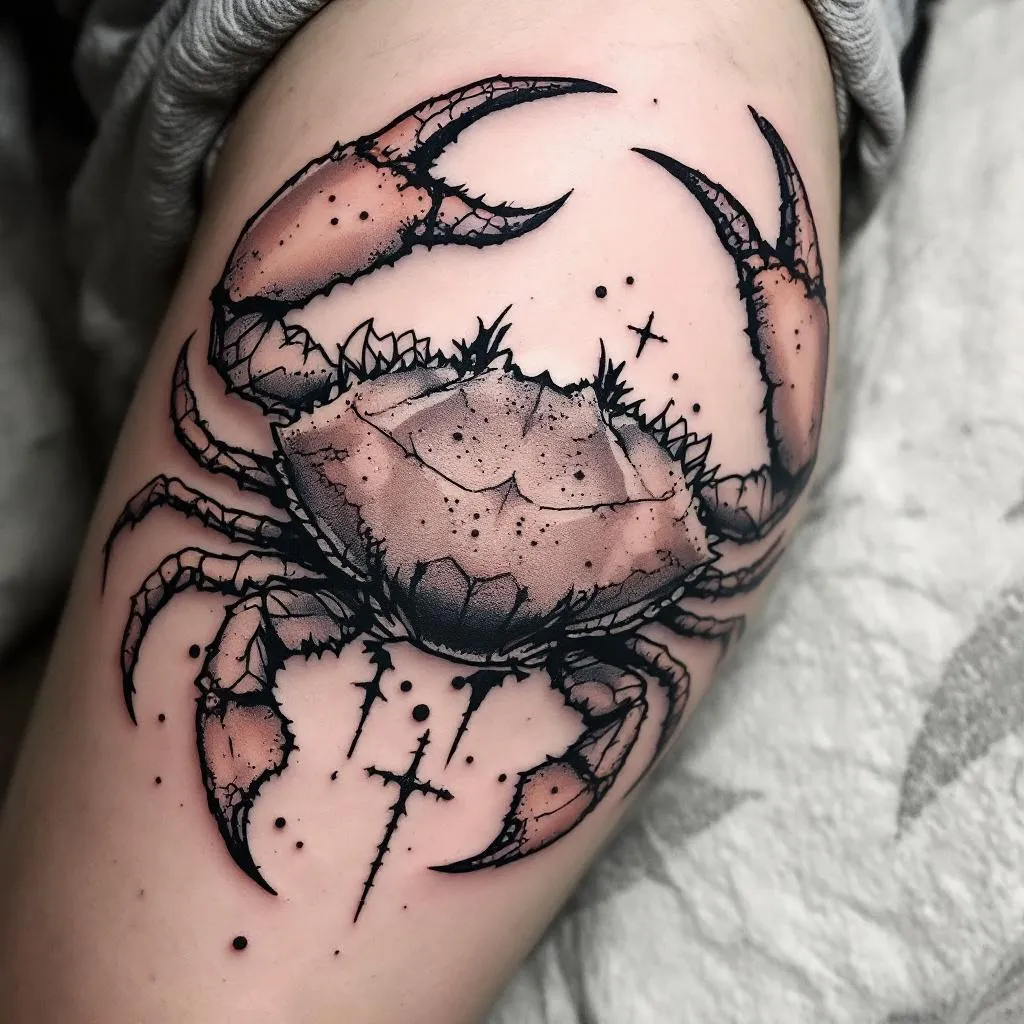
Crab, Knee, Leg Tattoo
✨ Design Your Dream TattooDesign Description
Finish my tattoo crab on knee body of dragoj goes around my leg around crab and finishes somewhere on the bottom of the leg and put details on body claws and stuff Use the same crab as on picture
Tattoo Meaning & Symbolism
Placing the same crab from your reference directly over the knee makes the crab the focal guardian of movement and vulnerability; its carapace centered on the patella reads like armor protecting a joint that we expose and test every day. The dragon body wrapping around your leg and encircling the crab turns that protection into a narrative of pursuit and containment — the dragon is both the force that moves around the crab and the force that completes it. Symbolically this composition blends resilience (the crab’s hard shell and regenerative claws) with power and wisdom (the dragon’s long, sinuous body). Together they describe a personal cycle: retreat and renewal (crab), guided transformation and mastery (dragon). Small details you requested — emphasized serrations on the crab claws, textured joints on the dragon’s coils, tiny barnacle or scale overlaps where shell meets scales — reinforce themes of survival, adaptation, and continuity between opposing elements (land/sea, defense/aggression).
Tattoo Style & Placement
This design works best as a hybrid of Japanese irezumi flow and neo-traditional realism: bold outlines and sweeping dragon coils for readable movement around the leg, combined with realistic shading and texturing on the crab shell and claws to preserve the exact character of the crab from your picture. The crab sits centered on the knee so that its carapace spans the patella, claws framing the kneecap slightly above and to either side; the dragon’s body exits behind the crab on one side, travels around the thigh and calf in a spiral, and finishes near the lower leg or just above the ankle as you requested. Because the knee moves and stretches, place heavier black linework on the crab’s shell edges and slightly looser, softer shading across the joint so the image retains cohesion while you bend. Add micro-detailing — fine scale texture, subtle highlight dots on the shell, and beveled edges on the claws — to keep the crab recognizable from the photo when viewed from multiple angles.
Personal & Cultural Significance
Using the exact crab from your photo gives the piece a highly personal identity: it becomes a literal extension of that original mark, now protected and accentuated by the dragon narrative. Culturally the crab often symbolizes protection, cyclical change (shedding and regrowth), and a connection to the tides or moon; the dragon represents authority, protection, and spiritual ascent in East Asian traditions. Combining them creates a layered cultural conversation — a coastal, grounded resilience wrapped by a celestial, protective force. For someone placing the crab on the knee, this can read as reclaiming vulnerability (the exposed joint) and turning it into a source of power: each bend of the leg reactivates the story of survival and guidance. Practical considerations reflect cultural tattoo practice too — heavier blacks and solid fills in areas that undergo more abrasion (like the lower leg) will help longevity, mirroring how traditional tattooing adapted designs to the body.
Similar Tattoo Ideas
- Knee-centered crab with a koi-dragon hybrid wrapping the leg and finishing at the ankle
- Full-leg Japanese-style dragon encircling multiple crustaceans, using the same crab as the centerpiece
- Black and grey realism crab on the knee with a neo-traditional dragon coil and gold highlights
- Dotwork crab shell texture transitioning into geometric dragon scales that spiral down the calf
- Color-saturated red/orange crab on the knee with an emerald and black Chinese dragon finishing at the lower leg
Conclusion
Keeping the exact crab from your picture as the central element honors the original mark while the wrapping dragon turns it into a dynamic, narrative sleeve that walks the line between defense and destiny. Thoughtful placement over the knee, careful scale-and-shade transitions where shell meets scales, and crisp claw detailing will preserve the crab’s individuality as the dragon completes the story down the leg. When you bring this to your artist, show the photo, discuss how the dragon will flow with muscle and bone, and plan for bold edges plus softer shading over the joint so the piece stays strong and readable as you move through life.
Similar Designs You Might Like


Try On
Preparing your design...
