 InkAI
InkAI 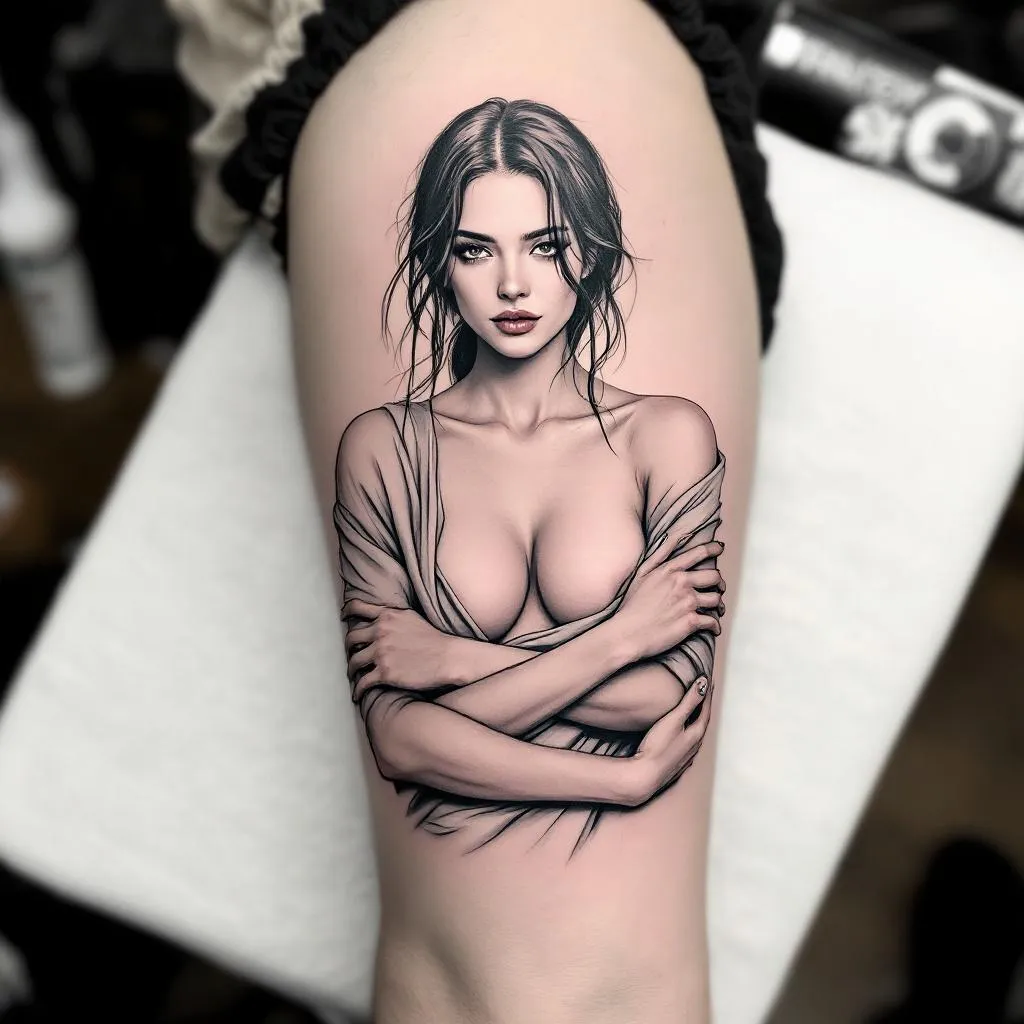
Upper Arm, Low Realism, Portrait Tattoo
Minimalist style
✨ Design Your Dream TattooDesign Description
A woman's arm tattoo with low realism, from head to chest, slightly averted gaze, expressionless face, fabric on the shoulders, revealing them and covering the chest, but the solar plexus itself is visible, the collarbones are clearly visible, the arms are not crossed but bent at the elbows, and the fingers of one hand overlap the fingers of the other, the hair is pulled back, loose in front and hanging slightly. The tattoo is intended for the upper arm and will eventually be part of a sleeve.
Tattoo Meaning & Symbolism
This upper-arm portrait of a woman from head to chest, rendered in low realism, communicates a deliberate tension between vulnerability and composed strength. The slightly averted gaze and expressionless face read as controlled introspection: she is present but not giving herself away, suggesting emotional reserve, quiet authority, or an inner watchfulness. The fabric that exposes the shoulders while covering the chest creates a visual paradox—shoulders bared (openness, readiness) while the chest is modestly shielded; yet the visible solar plexus becomes the true focal point, symbolizing personal power, will, and the seat of inward emotion rather than the outward heart. Prominent collarbones emphasize structural fragility and elegance, making the figure feel both statuesque and human.
The bent elbows and overlapping fingers are intimate gestures of containment and self-hold rather than aggression—an internal boundary, self-possession, or restrained yearning. Hair pulled back but loose at the front conveys discipline softened by approachable humanity: controlled identity with a small allowance for softness. Altogether the composition reads as a portrait of a person who is guarded yet centered, where authority comes from internal balance rather than outward expression.
Tattoo Style & Placement
In low realism this design will use simplified planes, deliberately softened facial anatomy, and measured contrast instead of micro-detail. Expect broad tonal shapes for the cheeks, collarbones, and drapery, with selective edges (sharp at the collarbones, softer at the fabric folds) to preserve readability on the upper arm. Render the solar plexus as a clear negative space or a targeted value focal point so it remains visible when the arm curves.
For placement as an upper-arm piece and eventual sleeve element, position the head and shoulders toward the outer biceps and shoulder cap so the face reads when the arm is relaxed. The chest and solar plexus should extend slightly toward the inner biceps/upper tricep to use the arm’s natural canvas and to allow the sleeve below to flow into the figure’s lower chest and hands. The bent elbows and overlapping fingers work well as transitional elements wrapping around the arm—use their angle to guide subsequent sleeve motifs. Choose medium-strong midtones and simplified highlights for longevity and legibility as the sleeve grows.
Personal & Cultural Significance
This portrait echoes long-standing visual traditions—classical busts and Renaissance drapery portraits—where revealed shoulders and covered chests denote dignity without overt sexuality. In contemporary tattoo culture, an expressionless, slightly averted female portrait often signals sovereignty over one’s emotions and a refusal to perform for the gaze of others. The visible solar plexus taps into cross-cultural concepts of core energy: in some systems it corresponds to the Manipura chakra (personal power and self-esteem), while in secular readings it becomes an emblem of personal resolve and gut truth. The overlapping fingers recall gestures of self-comfort found in photographic and painted studies of introspection, giving the piece a quiet narrative of self-containment and resilience.
On a personal level, this tattoo can mark a turning point where the wearer chooses inner authority over external validation, honors vulnerability as power, or memorializes a period of stoic endurance. Culturally it situates the wearer within a lineage of portraiture that prizes subtlety and presence over explicit storytelling.
Similar Tattoo Ideas
- Low-realism female bust with upward, introspective gaze for outer bicep
- Statuesque portrait with draped fabric and exposed collarbones—shoulder-to-upper-arm
- Minimalist portrait with a highlighted solar plexus (warm tone accent)
- Portrait with wrapped hands that transition into floral sleeve elements
- Simplified classical bust that integrates geometric background panels for sleeve flow
- Low-detail profile with pulled-back hair and loose front strands, placed on the outer arm
Conclusion
This tattoo is a compelling study in contrasts: reserve and exposure, softness and structure, anonymity and portraiture. Its low-realism execution and upper-arm placement make it especially well-suited to becoming the anchoring piece of a sleeve, with the solar plexus as a durable focal point and the overlapping hands serving as a natural bridge to additional elements. When you bring this idea to your tattooist, discuss scale, the tonal range needed for long-term clarity, and how you want the solar plexus treated (negative space, color accent, or subtle shading) so the final piece reflects the precise balance of vulnerability and quiet power you intend it to convey.
Similar Designs You Might Like
Try On
Preparing your design...
